The Word Is Right There
I posted on Reddit about two things that had been getting noticeably worse for me.
The first was the typing. I've always been a fast, clean typist. Now I'm swapping letters, dropping whole words. But what really gets me is the proofreading. I reread before I send. I look right at the message. I hit send. And then I immediately see three errors that were right there the whole time. My eyes just... slide over them. It's been happening multiple times a day for years, and it's frustrating in a way that's hard to explain to someone who isn't living it.
The second surprised me less, but bothered me just as much. The words. I'd be talking and the word just... leaves. Not a fancy word. A word I've used my entire life. I stand there with my mouth open. Buffering. It comes back eventually. Sometimes five seconds later. Sometimes twenty minutes later when I'm doing something completely different.
I'd been tracking and researching perimenopause symptoms for over two years while building PeriClue. Sleep fragmentation, HRV patterns, cycle-phase correlations. But these two? I never looked at them. The word-finding I sort of expected. But the typing thing caught me completely off guard. I just assumed I was being sloppy.
So I posted. I wanted to know: is this perimenopause? Is this just me? Am I okay?
What 400+ women told me
Over 400 people responded. Some were just "same" or "me too." But most weren't. Most were stories. Specific, detailed, emotional stories from women who had clearly been carrying this alone.
A transcriptionist who'd been flawless for 15 years, suddenly catching errors in her own work she'd never made before. Women who'd reread the same email five times and still miss something obvious. A lawyer who started dreading depositions because the legal terms she'd used for decades wouldn't come when she needed them. A teacher who forgot the word "cylinder" in front of her class and just stood there, hand on the shape, completely blank. Both things. Fingers misfiring and words disappearing. Over and over.
What hit me hardest wasn't the stories themselves. It was how many women said they thought something was seriously wrong with them. They'd been terrified. Some had gone through full blood panels, scans, and rounds of tests. Everything came back normal. And instead of that being reassuring, it made things worse. Because if nothing is wrong, then why can't I find my words?
And then the doctors. So many women described being dismissed. Not just about the cognitive stuff. About all of it. The fatigue, the sleep disruption, the anxiety that appeared from nowhere, the body that suddenly felt like a stranger's. "It's stress." "You're just getting older." "Your labs look fine." When your symptoms are real and measurable but your bloodwork doesn't flag anything, you start to wonder if you're making it up. You're not.
One woman wrote that she wished there was a way to know whether what she was experiencing was actually normal for this stage. That sentence stayed with me.
Getting to the bottom of it
The next day I sat down and started digging. Not casually. I wanted the actual science. Why my fingers keep making errors I would have never made two years ago. What's happening in the brain when words disappear. And where the research gaps are (because with perimenopause, there are always gaps).
I found the SWAN study first. It followed 2,362 women through the menopause transition and measured cognitive performance over four years. Processing speed dropped. Verbal memory dropped. Not self-reported complaints. Measurable declines on standardized tests [1].
Then I found Weber et al. [2], who looked at 117 women across different reproductive stages and measured something I hadn't considered: fine motor speed. It declined alongside verbal memory in early postmenopause. Not just the word-finding. The physical coordination between brain and fingers measurably changed.
Why it happens
Two things are going wrong at the same time, and they compound each other.
The typing part: This is where it gets interesting, because it's not just your brain. It's your hands.
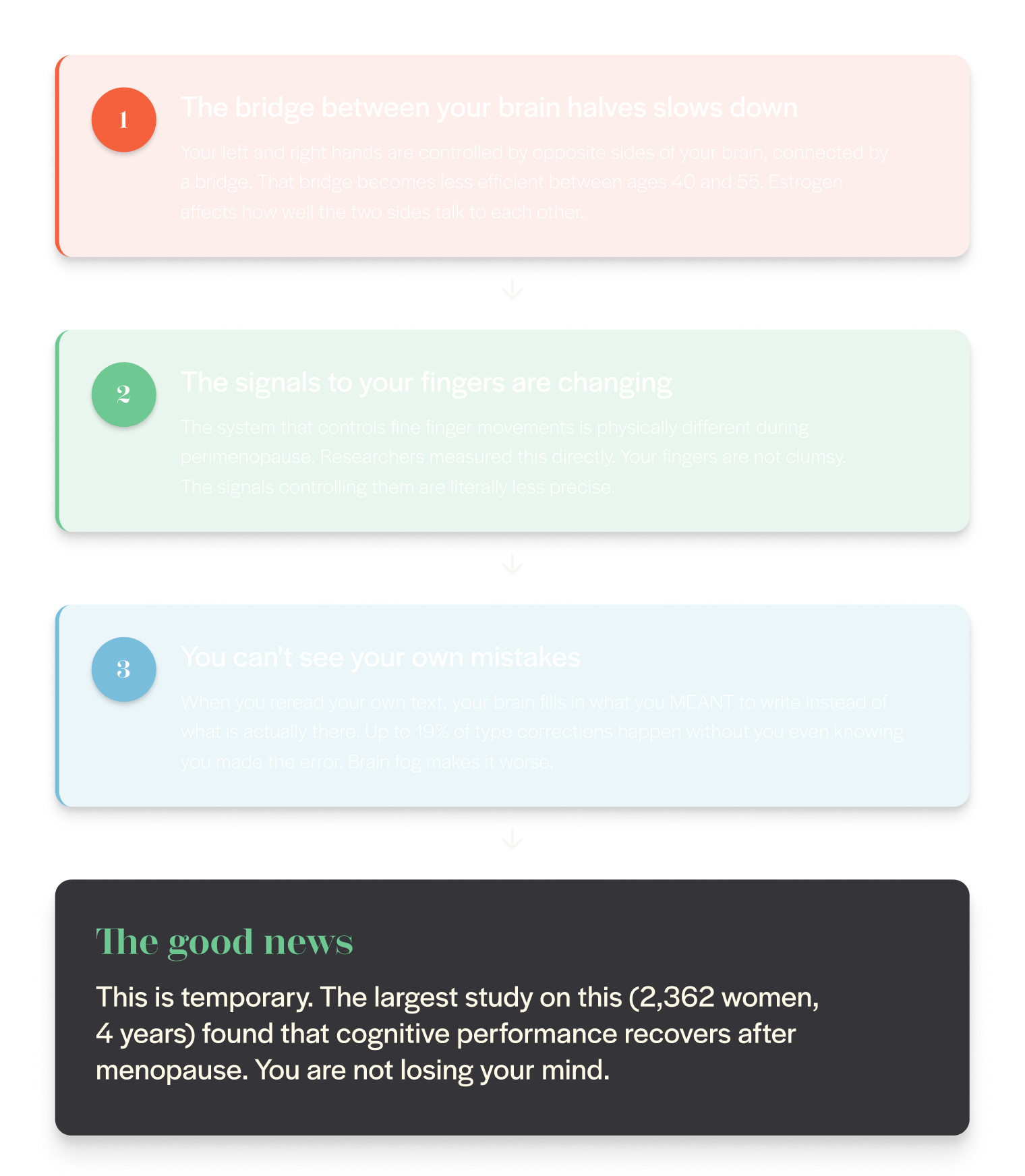
Your left and right hands are controlled by opposite sides of the brain, connected by a bridge called the corpus callosum. A study by Bellis and Wilber [3] found that this bridge starts working less efficiently between ages 40 and 55. The exact perimenopause window. And estrogen modulates how well the two sides of the brain communicate across it [4]. When estrogen fluctuates, the coordination between your left and right hand can literally become less precise.
On top of that, the neuromuscular control system itself is changing. Pesonen et al. [5] studied 63 perimenopausal women and found that the signals controlling muscle coordination were already changing. The excitatory and inhibitory mechanisms that tell your muscles when to fire and when to stop were measurably different between early and late perimenopause. Your fingers aren't just "being clumsy." The signals controlling them are physiologically different.
And then there's the proofreading problem. Your brain uses prediction when you reread your own text. It already knows what you meant to write, so it fills in the correct version automatically. Researchers found that up to 19% of typing error corrections happen without the typist even being aware they made an error [6]. When cognitive resources are already depleted from hormonal disruption and poor sleep, this prediction engine dominates even more. You literally cannot see your own mistakes. Not because you're careless. Because that's how the brain works under load.
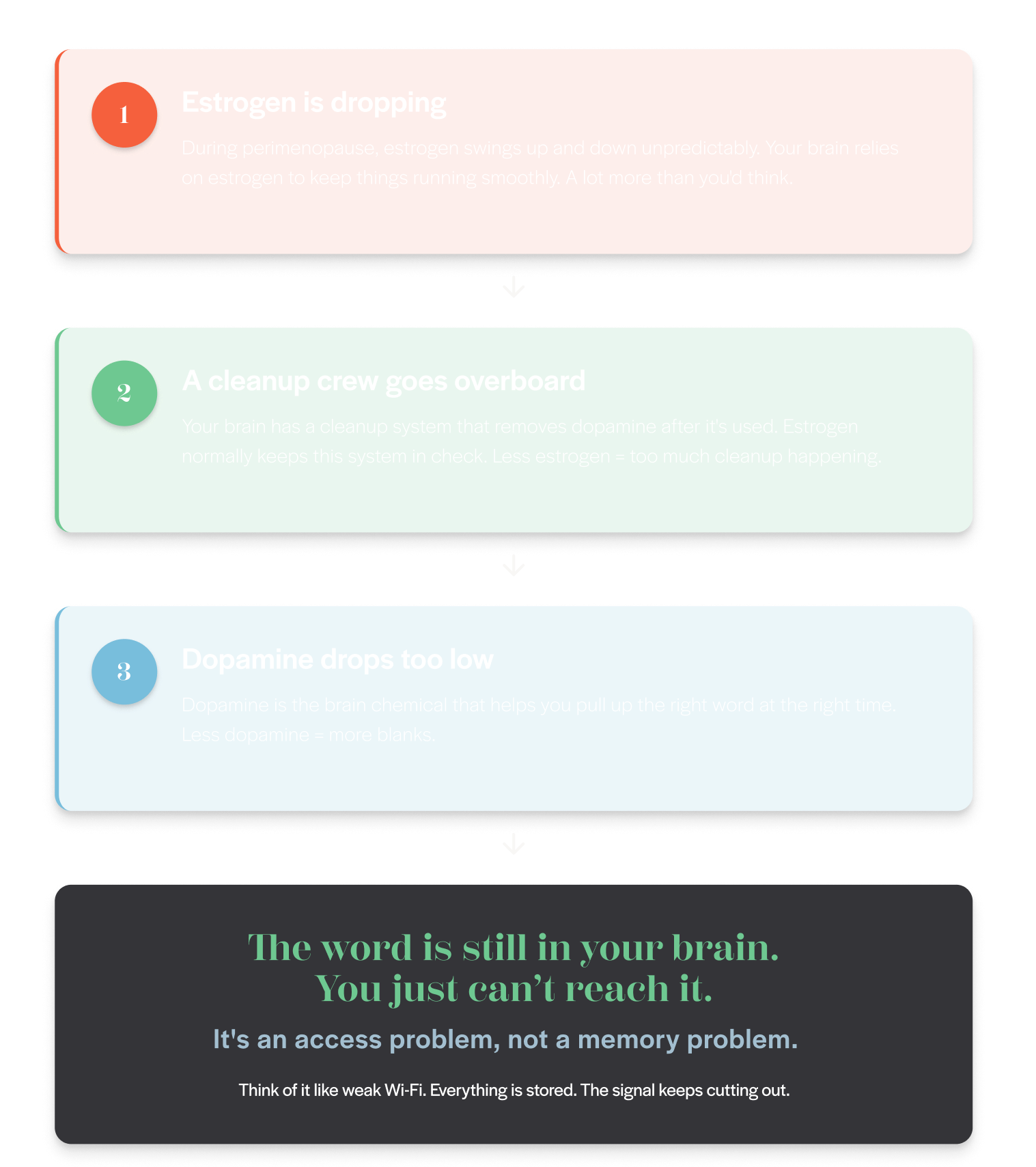
The word-finding part: Estrogen keeps a brain chemical called dopamine stable. Dopamine is what helps you pull up the right word at the right time. When estrogen swings wildly during perimenopause, dopamine becomes unpredictable. The word is still stored in your brain. The pathway to reach it gets disrupted. Not a storage problem. An access problem. Research by Jacobs and D'Esposito [7] showed that estrogen directly controls how much dopamine is available for working memory. When estrogen is unstable, so is the dopamine supply.
The part that mattered most
I spent a long time assuming I was losing something permanently. That this was the beginning of a decline that only goes one direction. I think a lot of the women in that Reddit thread were afraid of exactly the same thing. The ones who feared something serious weren't being dramatic. They were genuinely scared. And most of them had already been to doctors who told them nothing was wrong.
So I want to be clear about what the research says.
The SWAN data shows that cognitive performance recovers in postmenopause. The dip is real. It's measurable. But for the vast majority of women, it is temporary. The word-finding failures are functional (you can't access the word quickly) rather than structural (the word is gone from your brain). The access tends to come back as the transition settles.
This distinction matters. Because the fear of what these symptoms might mean is almost as heavy as the symptoms themselves.
What I'm doing with this
I track it. I noticed my word-finding is worse in the week before my period and on nights when my sleep efficiency drops below 80%. That pattern only became visible after about 60 days of consistent tracking.
I also stopped apologizing for it. "Sorry, lost my word" became "give me a second." Small shift. Real difference.
Some days I type a sentence and read it back three times and still miss an error that's obvious to everyone else. But knowing why it happens, knowing there's a measurable mechanism behind it and not just my brain falling apart, that changed how I carry it.
Over 400 women told me some version of the same story. If you're one of them, or if you would have been: you're not losing your mind. Your brain is working through conditions it wasn't prepared for. And the research says you come out the other side.
The short version
- Typing errors and proofreading blindness have a measurable physiological basis: interhemispheric coordination and neuromuscular control both change during the transition.
- Word-finding problems during perimenopause are an access problem, not a storage problem. The words are still there.
- Estrogen instability disrupts dopamine, which controls how quickly you can retrieve the right word at the right time.
- The SWAN study shows cognitive performance recovers in postmenopause. The dip is real, but for most women it is temporary.
- Over 400 women described the same experience. You are not losing your mind.
The research behind this post
[1] Greendale GA, Huang MH, Wight RG, et al. "Effects of the menopause transition and hormone use on cognitive performance in midlife women." Neurology. 2009;72(21):1850-1857. The SWAN study. 2,362 women followed over 4 years. Measured cognitive performance across the menopause transition. PubMed
[2] Weber MT, Rubin LH, Maki PM. "Cognition in perimenopause: the effect of transition stage." Menopause. 2013;20(5):511-517. 117 women across reproductive stages. Measured six cognitive domains including fine motor speed (Grooved Pegboard Test). PubMed | Full text
[3] Bellis TJ, Wilber LA. "Effects of aging and gender on interhemispheric function." J Speech Lang Hear Res. 2001;44(2):246-263. Found that interhemispheric function declines between ages 40 and 55. PubMed
[4] Weis S, Hausmann M, Stoffers B, et al. "Estradiol modulates functional brain organization during the menstrual cycle: an analysis of interhemispheric inhibition." J Neurosci. 2008;28(50):13401-13410. Showed that estradiol modulates how well the two hemispheres of the brain communicate. PubMed
[5] Pesonen H, Laakkonen EK, Hautasaari P, et al. "Perimenopausal women show modulation of excitatory and inhibitory neuromuscular mechanisms." BMC Womens Health. 2021;21(1):133. 63 perimenopausal women. Measured excitatory and inhibitory neuromuscular mechanisms across early and late perimenopause. PubMed
[6] Pinet S, Nozari N. "Correction without consciousness in complex tasks: evidence from typing." J Cogn. 2022;5(1):11. 145 participants, nearly 15,000 typing errors. Found that up to 19% of error corrections happen without conscious awareness. PubMed | Full text
[7] Jacobs E, D'Esposito M. "Estrogen shapes dopamine-dependent cognitive processes: implications for women's health." J Neurosci. 2011;31(14):5286-5293. Demonstrated that estrogen directly controls dopamine availability for working memory. PubMed